
Futher Resources from Talk
My personal website: matt-tompkins.com
Linkden profile: linkedin.com/in/matthew-tompkins/
Lab website: lucs.lu.se/research/choice-blindness-lab/home/
What is Choice Blindness (TED Talk): youtube.com/watch?v=tuEGoAabL9o
Choice Blindness and consumer preferences: Link
Choice Blindness and Political Preferences: journals.plos.org/plosone/article?id=10.1371/journal.pone.0226799
The Science of Magic Association (SoMA): An organization I co-founded that’s designed to facilitate interdisciplinary collaboration
Recommended Readings:
Tompkins, M. L. (2023)Forskar Grand Prix- Seeing through illusions. https://www.matt-tompkins.com/blog/2022/12/2/forskar-grand-prix-seeing-through-illusions
(a written break-down of the techniques and methodology behind my talk’s opening minutes)
Rensink, R. A., and Kuhn, G. (2015). A framework for using magic to study the mind. Front. Psychol. 5:1508. doi: 10.3389/fpsyg.2014.01508
(A recent theoretical of using magic in laboratory)
Tompkins, M. L., Woods, A. T., & Davies, A. M. A. (2016). The Phantom Vanish Magic Trick: Investigating the Disappearance of a Non-existent Object in a Dynamic Scene. Frontiers in Psychology, 7.
(An example of how magic trick methods can be adapted for empirical laboratory studies of perception)
Tompkins, M. L. (2019). The Spectacle of Illusion: Magic, the paranormal & the complicity of the mind. London: Thames & Hudson. ISBN: 978-1-942884-37-8
(A narrative historical survey of interactions between mystics, magicians, and scientists)
Additional References:
Hodgson, R., & Davey, S. (1887). The possibilities of mal-observation and lapse of memory from a practical point of view. Proceedings of the Society for Psychical Research, 4, 381-495.
Johansson, P., Hall, L., Sikstrom, S., & Olsson, A. (2005). Failure to detect mismatches between intention and outcome in a simple decision task. Science, 310, 116-119.
Kanizsa, G. (1987). Quasi-perceptual margins in homogeneously stimulated fields. In S. Petry & G. E. Meyer (Eds.). The perception of illusory contours (pp. 40-49). New York: Springer.
Kuhn, G. (2019). Experiencing the impossible: The science of magic. London: MIT Press.
Kuhn, G., & Rensink, R. A. (2016). The vanishing ball illusion: A new perspective on the perception of dynamic events. Cognition, 148, 64-70.
Kuhn, G. & Tatler, B. W. (2005). Magic and fixation: Now you don't see it, now you do. Perception, 34, 1153-1161.
Lamont, P., & Wiseman, R. (2005). Magic in theory: An introduction to the theoretical and psychological elements of conjuring. Hatfield: University of Hertfordshire Press.
Levin, D. T., & Simons, D. J. (1997). Failure to detect changes to attended objects in motion pictures. Psychonomic Bulletin & Review, 4(4), 501-506.
Levin, D. T., Momen, N., Drivdahl IV, S. B., & Simons, D. J. (2000). Change blindness blindness: The metacognitive error of overestimating change-detection ability. Visual Cognition, 7(1-3), 397-412
Rensink, R. A. (2018). To have seen or not to have seen: a look at Rensink, O’Regan, and Clark (1997). Perspectives on Psychological Science, 13(2), 230-235.
Rensink, R. A., O'Regan, J. K., & Clark, J. J. (1997). To see or not to see: The need for attention to perceive changes in scenes. Psychological science, 8(5), 368-373.
Scot, R. (1854). The Discoverie of Witchcraft, wherein the lewde dealing of witches and witchmongers is notablie detected, the knaverie of conjurors, the impietie of inchantors, the follie of soothsaiers, the impudent falsehood of cousenors, the infidelitie of atheists, the pestilent practices of Pythonist, the curiositie of figurecasters, the vanitie of dreamers, the beggerlie art of Alcumystrie, The abhomination of idolatrie, the horrible art of poisoning, the vertue and power of natural magike, and all the conveiances of Legierdemaine and juggling are deciphered: and many other things opened, which have long lien hidden, howbeit verie necessarie to be knowne. Heereunto is added a treatise upon the nature and substance of spirits and divels, &c... London: William Brome.
Simons, D. J., & Chabris, C. F. (2011). What people believe about how memory works: A representative survey of the US population. PloS one, 6(8), e22757.
Thomas, C., Didierjean, A., Maquestiaux, F., & Gygax, P. (2015). Does Magic Offer a Cryptozoology Ground for Psychology? Review of General Psychology, 19, 117-128.
Tompkins, M. L. (2019). The Spectacle of Illusion. London: Thames & Hudson.
Tompkins, M. L. (2026). Haunted Histories of Experimental Psychology: A Re-Examination of Hodgson and Davey’s Mal-Observation Report. Advances in Nineteenth-Century Research, 1(1), 95-117.
Illusion Demos
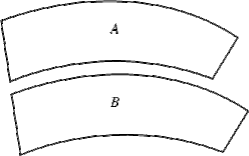
Wundt-Jastrow Illusion
https://en.wikipedia.org/wiki/Jastrow_illusion#/media/File:Jastrow_illusion.gif
First appeared in print in an 1873 book The World of Wonders. Psychologist Franz Müller-Lyer included it in a collection of optical illusions (1889). And the image was further popularized by both Joseph Jastrow and Wilhelm Wundt.
Jastrow, Joseph (1892-01-01). "Studies from the Laboratory of Experimental Psychology of the University of Wisconsin. II". The American Journal of Psychology. 4 (3): 381–428.
Müller-Lyer, F. C. (1889). "Optische Urteilstauschungen". Archiv für Anatomie und Physiologie (Supplement). Jahrg.1889 suppl.
Wundt, Wilhelm Max (1898). Die Geometrisch-Optischen Täuschungen. Leipzig: B. G. Teubner.
Light and Heavy Boxes
A size weight illusion also known as the Charpentier Illusion- named for the french physician who first described the effect in 1891.
Charpentier, A (1891). "Analyse experimentale: De quelques elements de la sensation de poids [Experimental study of some aspects of weight perception]". Arch Physiol Norm Pathol. 3: 122–135.
Won, I., Gross, S., & Firestone, C. (2021). “Impossible” Somatosensation and the (Ir) rationality of Perception. Open Mind, 5, 30-41.
Scintillating Grid
https://en.wikipedia.org/wiki/Grid_illusion#/media/File:Grid_illusion.svg
A variation on the Hermann Grid Illusion (1870) developed by Bergen (1985).
Bergen, J. R. (1985) Hermann's grid: new and improved (abstract), Investigative Ophthalmology and Visual Science, Supplement, 26: 280.
Hermann, L. (1870). Eine erscheinung simultanen contrastes. Archiv für die gesamte Physiologie des Menschen und der Tiere, 3(1), 13-15.
Schrauf, M., Lingelbach, B., & Wist, E. R. (1997). The scintillating grid illusion. Vision research, 37(8), 1033-1038.
Schrauf, M.; Lingelbach, B.; Lingelbach, E.; Wist, E. R. (1995). "The Hermann Grid and the scintillation effect". Perception. 24 Suppl. A: 88–89.
Spillmann L (1994) The Hermann Grid Illusion: a Tool for Studying Human Perceptive Field Organization. Perception 23:691–708
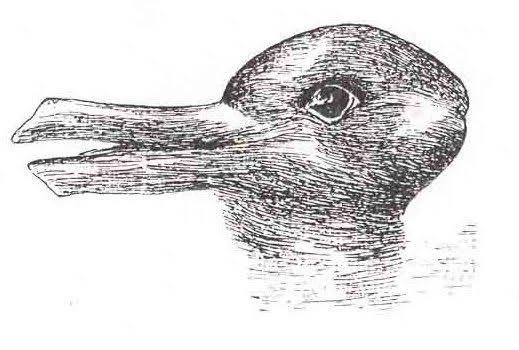
DuckRabbit Figure
https://en.wikipedia.org/wiki/Rabbit%E2%80%93duck_illusion#/media/File:Kaninchen_und_Ente.svg
Based on an image that first appeared in the German Humor magazine Fliegende Blätter in 1892. It was later popularized the by both the psychologist Joseph Jastrow and the philosopher Ludwig Wittgenstein. The 3D printed version on display today is a variation was designed by Kyle Galbraith.
Anynomous Illustrator, 1892. 'Welche Thiere gleichen einander am meisten?' Fliegende Blätter. Braun & Schneider.
Jastrow, J. "The Mind's Eye." Popular Sci. Monthly 54, 299-312, 1899.
Wittgenstein, L. Philosophical Investigations. Oxford, England: Blackwell, pp. 165-166, 1953/1958.
Optic Scotoma Demo
First discovered by in the 1660s by Edme Mariotte. Prior to this, physiologists mistakenly believed that the dense nerve fibers in this area of the eye were highly sensitive, when in fact they do not detect light.
Grzybowski, A., & Aydin, P. (2007). Edme Mariotte (1620–1684): pioneer of neurophysiology. Survey of ophthalmology, 52(4), 443-451.
Mariotte, E., Pecquet, J., & Justel, R. L. (1968). A new discovery touching vision. Philosophical Transactions of the Royal Society of London, 3(35), 668-671.
Rotating Snakes Illusion
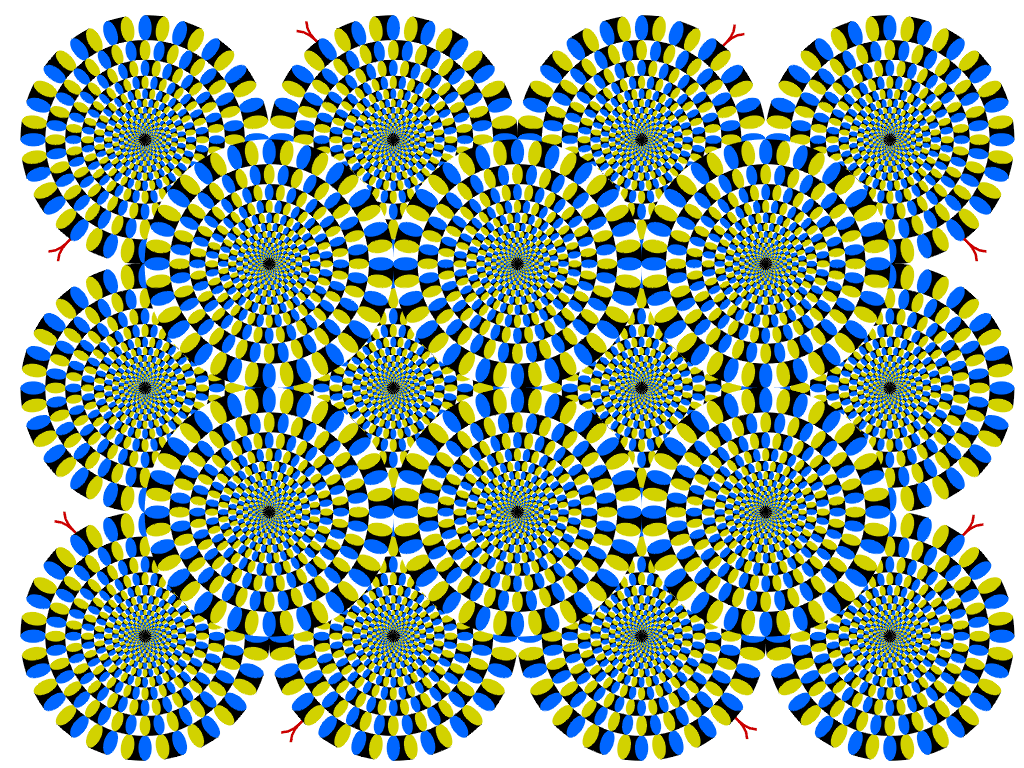
A now classic anomalous motion illusion developed by Prof. Akiyoshi Kitaoka: https://www.ritsumei.ac.jp/~akitaoka/index-e.html
Ashida, H., & Kitaoka, A. (2003). A gradient-based model of the peripheral drift illusion. Perception, 32(Suppl.), 106.
Backus, B. T., & Oruç, I. (2005). Illusory motion from change over time in the response to contrast and luminance. Journal of vision, 5(11), 10-10.
Shephard Tables
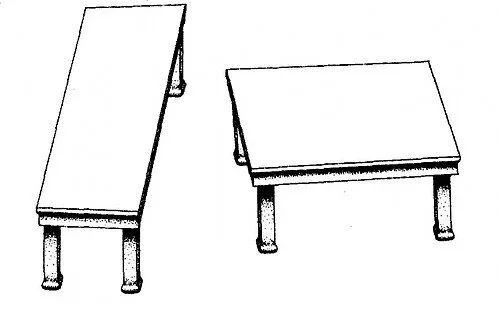
https://en.wikipedia.org/wiki/Shepard_tables#/media/File:Table_shepard.preview.jpg
An illusion developed by Stanford psychologist Roger N. Shepard in 1990.
Shepard, R. N. (1990). Mind Sights: Original visual Illusions, Ambiguities, and other Anomalies, with a Commentary on the play of mind in Perception and art. WH Freeman/Times Books/Henry Holt & Co.
Shrinking Finger Illusion
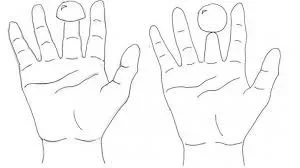


This proprioceptive illusion was developed by Vebjørn Ekroll and colleagues in 2016.
Ekroll, V., Sayim, B., Van der Hallen, R., & Wagemans, J. (2016). Illusory visual completion of an object’s invisible backside can make your finger feel shorter. Current Biology, 26(8), 1029-1033.
IdeoMotor Action
The Spirit Board on display was actually banned in the UK in 2020, because of fears it might expose children to otherworldly demons. The psychological phenomena of ideomotor action (Carpeter, 1852) offers a more earthly explanation of how table tilting sessions, Ouija Boards, Dowsing Rods, and Pendulums can seem to operate from uncanny external forces. Sometimes, particularly when we’re making very small motor actions, we can be entirely unaware that we’re moving. When these small actions are amplified by instruments like pendulums or dowsing rods it can create a powerful illusion that some external force is acting on the object.
Andersen, M., Nielbo, K. L., Schjoedt, U., Pfeiffer, T., Roepstorff, A., & Sørensen, J. (2019). Predictive minds in Ouija board sessions. Phenomenology and the Cognitive Sciences, 18(3), 577-588.
Carpenter, W.B. (1852) On the Influence of Suggestion in Modifying and directing Muscular Movement, independently of Volition. Royal Institution of Great Britain, 147–153.
Gauchou, H. L., Rensink, R. A., & Fels, S. (2012). Expression of nonconscious knowledge via ideomotor actions. Consciousness and Cognition, 21(2), 976-982.
https://wellcomecollection.org/stories/the-psychology-of-ouija